Quick takeaways
Build a system that still works when you come back tired.
- Linear lists lack context, making tasks feel disconnected and meaningless.
- ADHD brains struggle with working memory and object permanence, requiring connected context.
- Fragmented tools increase cognitive switching costs and lead to system abandonment.
- A workspace that connects notes, tasks, and goals keeps the big picture visible.
The linear list problem: No context, no interest
To-do lists are usually built as simple vertical stacks of text. While this works for some, ADHD brains are highly contextual and associative. A flat, isolated task like 'Call landlord' or 'Draft email' has no immediate story attached to it.
Without the surrounding context—why this task matters, what notes are related, or what goal it supports—the task feels dry and uninteresting. Since the ADHD brain is driven by interest, novelty, and urgency, a contextless task fails to spark the motivation needed to act.
Working memory and the cost of tool-hopping
When your notes live in one app, your tasks in another, and your goals in a third, you are constantly forced to context-switch. Every time you switch apps, your working memory is taxed.
For someone with ADHD, this switching cost is where ideas and focus go to die. You open your notes app to find a reference, get distracted by another file, and completely forget the task you were working on in the first place.
- Tool fragmentation increases the cognitive load of planning.
- Important context gets lost in the gaps between different applications.
- The friction of moving between apps makes the system hard to maintain.
What to do instead: The power of a connected workspace
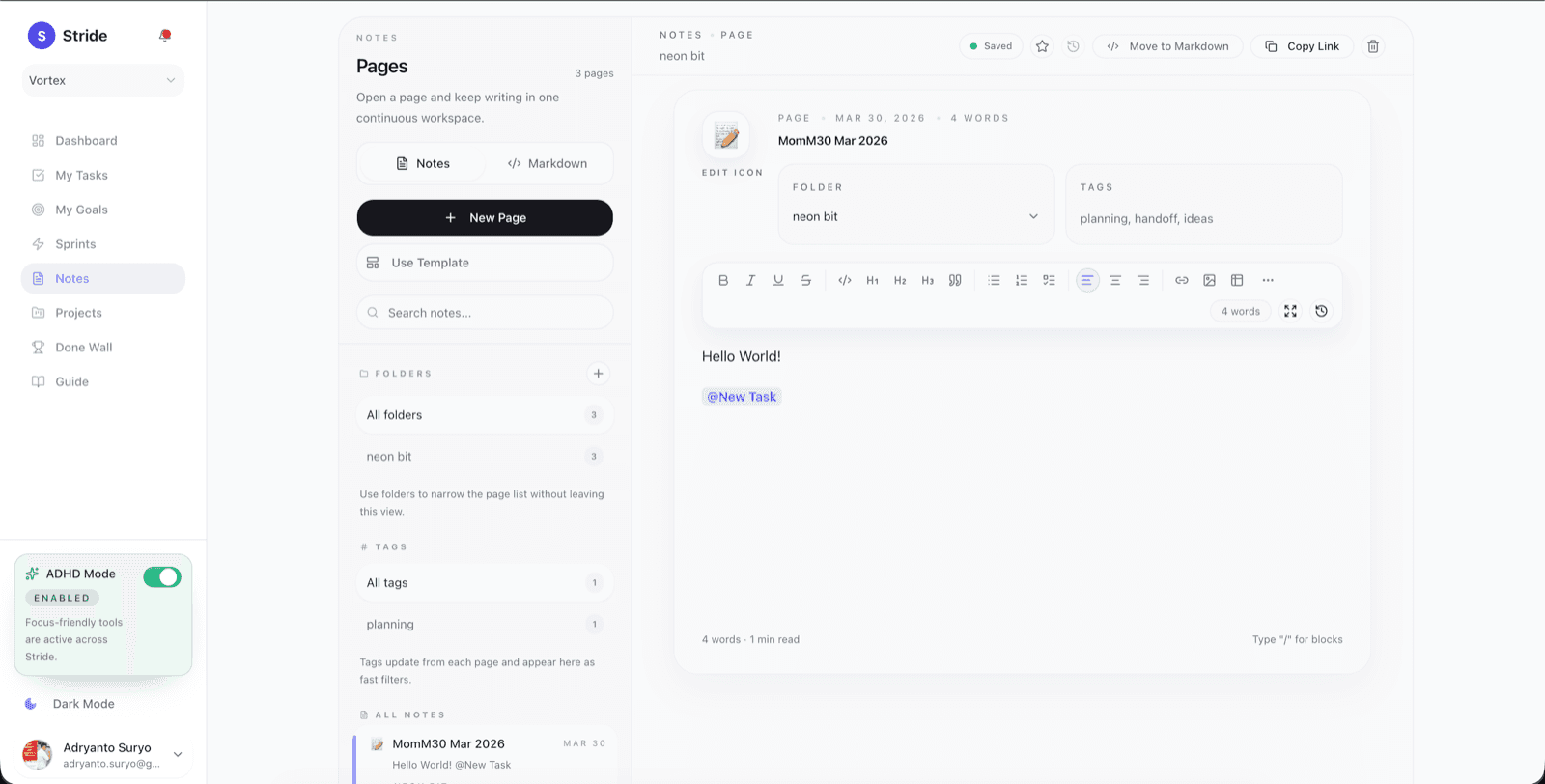
An ADHD-friendly system connects the dots. Instead of keeping notes and tasks separate, they should exist in the same environment, linked directly to each other.
When you open a task, the relevant meeting notes, files, and background thoughts are right there. You don't have to search for them or hold them in your head. The path to starting the work is entirely friction-free because the context is pre-loaded.
- Link meeting notes directly to the tasks they generate.
- Keep references and active work items side-by-side.
- Keep the 'why' (the goal) visible alongside the 'what' (the task).
Designing for the moments you drift
Most systems assume you will use them perfectly every day. An ADHD-friendly workspace expects you to drift. It is designed to make re-entry as smooth as possible.
By keeping notes, tasks, and goals connected in one calm, integrated workspace like Stride, you create a trail of breadcrumbs. When you return after a distracted hour or a chaotic week, you can quickly trace your way back to your flow state without having to rebuild your system from scratch.
Calmer Focus Awaits
Try Stride for free — the calm workspace built for ADHD brains.
Traditional tools make you manage lists. Stride works with how ADHD brains actually function: quick capture for fleeting thoughts before they distract you, narrowing the day to a Daily 3, and reviewing the friction behind missed work instead of piling on the guilt.