Quick takeaways
Build a system that still works when you come back tired.
- Long to-do lists trigger task paralysis by overwhelming executive functions.
- The Daily 3 narrows the day's focus to reduce cognitive overload and decision fatigue.
- Start with small, immediate actions to build momentum and dopamine.
- Keep the remaining backlog hidden so it doesn't distract or stress you.
Why long to-do lists cause ADHD brains to freeze
Traditional productivity systems advise you to write down everything you need to do in one long, master list. But for ADHD brains, seeing twenty or thirty open tasks at once doesn't motivate—it paralyzes. This is known as ADHD task paralysis or choice paralysis.
When the brain's executive function is overloaded, every item on the list competing for attention feels equally urgent and important. Lacking a natural mechanism to prioritize automatically, the brain gets stuck trying to decide where to start, resulting in procrastination and anxiety.
How the Daily 3 method lowers the threshold to start
The Daily 3 is a simple design constraint: you choose exactly three tasks to focus on today. Everything else stays in the backlog, hidden from view.
By shrinking the day's horizon, you eliminate decision fatigue. You no longer have to ask, 'What should I do next?' among dozens of items; you only have to look at three. This makes the initial barrier to starting feel manageable rather than insurmountable.
- Pick three tasks that will make the day feel successful if completed.
- Move the rest of the list out of sight to protect your working memory.
- Accept that finishing these three is enough, creating a sense of completion.
Breaking tasks down into micro-steps to build dopamine
Even with only three tasks, task paralysis can still strike if the tasks themselves are too large or vague. 'Write report' is a project, not a single task. An ADHD-friendly task needs to be concrete and small.
Breaking a task down into a micro-step—something that takes less than five minutes—helps generate the dopamine needed to cross the starting line. Once you take that first step, momentum takes over, and continuing becomes much easier.
- Turn 'work on taxes' into 'find last month's receipts.'
- Define the exact tool, website, or document you need to open.
- Focus only on the first five minutes of the task.
How Stride supports the Daily 3 workflow
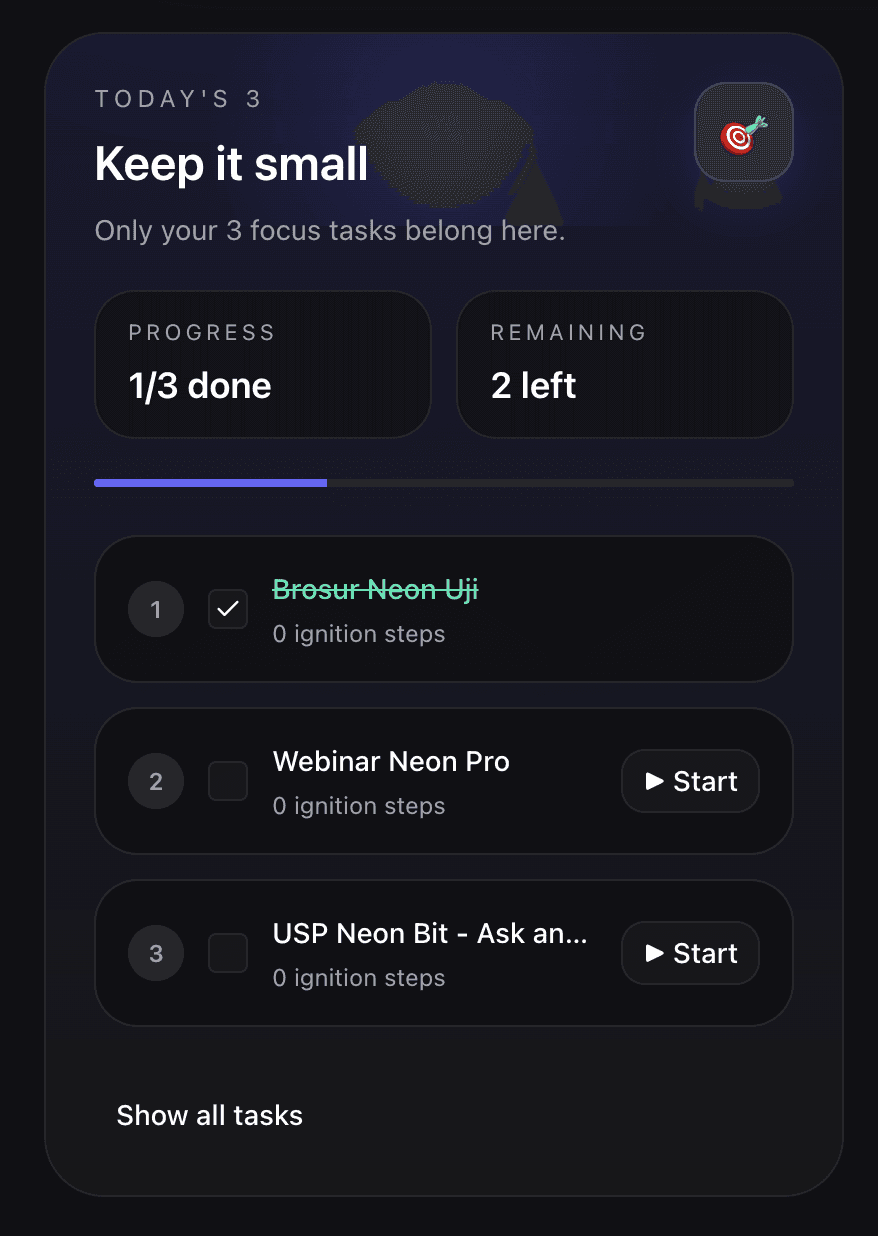
Stride is built around this exact workflow. Rather than forcing you to look at a chaotic inbox all day, Stride lets you drag tasks into a dedicated Daily 3 lane.
This creates a visual boundary around your day, keeping your focus isolated. If you get distracted or interrupted, you don't return to a scary list of fifty items—you return to your Daily 3, making it simple to find your place and restart.
Calmer Focus Awaits
Try Stride for free — the calm workspace built for ADHD brains.
Traditional tools make you manage lists. Stride works with how ADHD brains actually function: quick capture for fleeting thoughts before they distract you, narrowing the day to a Daily 3, and reviewing the friction behind missed work instead of piling on the guilt.